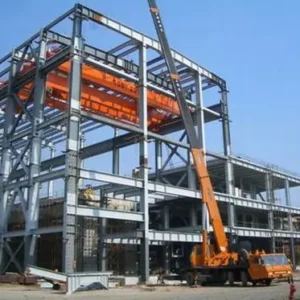



EN 10025 S235JR vs S355JR – Which Steel Should You Choose
Product Menu
- Steel Bar
- Powder High-speed Steel
- Aerospace Alloy Bar
- Aerospace Alloy Sheet
- Titanium Alloy Strip Coil/Sheet/Foil
- Titanium Alloy Pipe and Fitting
- Aluminum Strip Coil/Sheet
- Stainless Steel Strip Coil/Sheet
- Hot-rolled Steel Strip Coil/Sheet
- Cold-rolled Steel Strip Coil/Sheet
- Galvanized Steel Strip Coil/Sheet
- Color-coated Steel Strip Coil/Sheet
- Seamless Steel Pipe
- Welded Steel Pipe
- H-shaped Steel
- Angle Steel/Channel Steel

EN 10025 S235JR Structural Steel Plate & EN 10025 S355JR Steel Plate – Properties, Applications, and Comparison
Introduction
The EN 10025 standard specifies structural steel grades widely used in construction, engineering, and fabrication across Europe and beyond. Among its grades, S235JR and S355JR are two of the most commonly used.
While both are non-alloy structural steels with excellent weldability, they differ in mechanical strength, making them suitable for different load-bearing and performance requirements. Understanding these differences helps engineers and fabricators select the right material for cost efficiency and safety.
EN 10025 S235JR Structural Steel Plate
Overview
S235JR is a non-alloy, low-carbon structural steel with a minimum yield strength of 235 MPa. It is highly versatile, easy to machine, and offers good weldability, making it ideal for general construction projects.
Chemical Composition (Typical)
Carbon (C): ≤ 0.17%
Manganese (Mn): ≤ 1.40%
Phosphorus (P): ≤ 0.035%
Sulfur (S): ≤ 0.035%
Nitrogen (N): ≤ 0.012%
Mechanical Properties
Yield Strength: ≥ 235 MPa
Tensile Strength: 360–510 MPa
Elongation: ≥ 26% (for thickness ≤ 16 mm)
Impact Energy: 27 J at +20°C (JR designation)
Key Advantages
Good formability for bending and shaping
Excellent weldability without preheating
Readily available and cost-effective
Suitable for normal temperature conditions
Common Applications
Building frames and beams
Bridges and walkways
Structural supports
General metal fabrication
Machinery frames and components
EN 10025 S355JR Steel Plate
Overview
S355JR is a higher-strength non-alloy structural steel with a minimum yield strength of 355 MPa. It retains the good weldability of S235JR but offers greater load-bearing capacity, making it better suited for demanding structural applications.
Chemical Composition (Typical)
Carbon (C): ≤ 0.20%
Manganese (Mn): ≤ 1.60%
Phosphorus (P): ≤ 0.035%
Sulfur (S): ≤ 0.035%
Nitrogen (N): ≤ 0.012%
Mechanical Properties
Yield Strength: ≥ 355 MPa
Tensile Strength: 470–630 MPa
Elongation: ≥ 22% (for thickness ≤ 16 mm)
Impact Energy: 27 J at +20°C (JR designation)
Key Advantages
Higher strength-to-weight ratio than S235JR
Good impact resistance
Excellent weldability for thick sections
Allows for lighter structures without compromising safety
Common Applications
Heavy-duty building frameworks
Bridges and offshore structures
Pressure-bearing structures
Transport equipment and cranes
Industrial platforms
Comparison: EN 10025 S235JR vs S355JR
| Feature / Property | S235JR | S355JR |
|---|---|---|
| Minimum Yield (MPa) | 235 | 355 |
| Tensile Strength (MPa) | 360–510 | 470–630 |
| Weldability | Excellent | Excellent |
| Formability | Higher | Slightly lower |
| Cost | Lower | Higher |
| Applications | General construction | Heavy-duty structures |
Conclusion
Both EN 10025 S235JR and S355JR steel plates are excellent choices for structural applications.
S235JR is ideal for general-purpose use where moderate strength is sufficient and cost efficiency is a priority.
S355JR offers higher strength for demanding projects, enabling reduced material thickness while maintaining structural integrity.
Selecting between them depends on load requirements, structural design, and budget considerations.
Lastest Posts List
OEM & ODM
Highly precise technical design team,the design and production of tailored solutions for you.
Contact
Related Posts
Order Steel Plates Online with...
How to Find the Steel...
EN10025 S355J0W Weathering Steel Price...
Seasonal Pricing for Galvanized Strip...
Midwest Steel Supply Expands Footprint...
ASTM Standards Steel for Power...
Steel Fabrication for Power Infrastructure...
High Strength Steel for Transmission...
Steel Materials for Power Engineering...