


Aerospace Bars and Aerospace Alloy Plates
Product Menu
- Steel Bar
- Powder High-speed Steel
- Aerospace Alloy Bar
- Aerospace Alloy Sheet
- Titanium Alloy Strip Coil/Sheet/Foil
- Titanium Alloy Pipe and Fitting
- Aluminum Strip Coil/Sheet
- Stainless Steel Strip Coil/Sheet
- Hot-rolled Steel Strip Coil/Sheet
- Cold-rolled Steel Strip Coil/Sheet
- Galvanized Steel Strip Coil/Sheet
- Color-coated Steel Strip Coil/Sheet
- Seamless Steel Pipe
- Welded Steel Pipe
- H-shaped Steel
- Angle Steel/Channel Steel
Precision Metal Solutions for Flight, Defense, and Space Applications
The aerospace industry demands materials that meet the highest standards of performance, reliability, and safety. Components used in aircraft, spacecraft, and defense systems must withstand extreme mechanical stress, temperature variations, fatigue loading, and corrosive environments while maintaining minimal weight. To meet these challenges, manufacturers rely heavily on aerospace bars and aerospace alloy plates—specialized metal products engineered to exacting specifications.
These materials form the structural and functional backbone of modern aerospace systems, enabling safe flight, efficient fuel use, and long service life. This article explores the characteristics, properties, manufacturing considerations, and applications of aerospace bars and aerospace alloy plates.
Understanding Aerospace-Grade Materials
Aerospace materials differ significantly from standard industrial metals. They must comply with strict quality controls, precise chemical compositions, and tight dimensional tolerances. Aerospace bars and plates are produced from carefully selected alloys and undergo rigorous inspection to ensure consistency, traceability, and performance.
Typical aerospace alloys include aluminum, titanium, nickel-based alloys, and high-performance steels, each chosen based on strength, weight, temperature resistance, and fatigue behavior.
Aerospace Bars
Definition and Forms
Aerospace bars are solid metal products supplied in shapes such as round, square, rectangular, and hexagonal bars. These bars serve as raw material for machining critical aerospace components that require high structural integrity and precise mechanical performance.
Aerospace bars are commonly produced from aluminum alloys, titanium alloys, alloy steels, and nickel-based alloys. They are used in both structural and load-bearing applications, as well as in precision-machined parts.
Key Properties of Aerospace Bars
1. High Strength-to-Weight Ratio
One of the most important requirements in aerospace design is reducing weight without sacrificing strength. Aerospace bars, especially those made from advanced aluminum and titanium alloys, deliver exceptional strength relative to their weight, contributing to improved fuel efficiency and payload capacity.
2. Fatigue Resistance
Aircraft components experience repeated cyclic loading throughout their service life. Aerospace bars are engineered to resist fatigue cracking and maintain mechanical integrity over millions of stress cycles.
3. Dimensional Accuracy and Consistency
Aerospace bars are produced with tight dimensional tolerances to ensure reliable machining and precise component fit. This accuracy reduces material waste and improves manufacturing efficiency.
4. Corrosion Resistance
Many aerospace environments expose components to moisture, chemicals, and temperature extremes. Alloying elements such as chromium, nickel, and aluminum enhance corrosion resistance and extend service life.
5. Heat and Stress Performance
Certain aerospace bars are designed to perform at elevated temperatures and under high stress, making them suitable for engine components and high-load structural parts.
Applications of Aerospace Bars
Aerospace bars are widely used across commercial, military, and space programs:
Aircraft structural fittings and fasteners
Landing gear components and support structures
Engine shafts, rings, and rotating parts
Actuator components and control system elements
Defense and space hardware requiring precision machining
Manufacturers such as Boeing and Airbus rely on aerospace-grade bar stock to produce components that meet stringent performance and safety standards.
Aerospace Alloy Plates
Definition and Characteristics
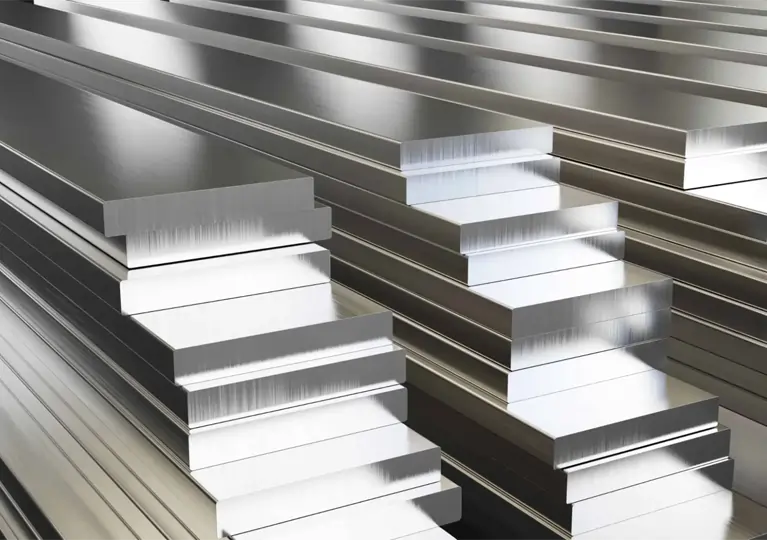
Aerospace alloy plates are flat-rolled metal products with controlled thickness and surface quality. These plates are used for structural panels, skins, bulkheads, and load-distributing components in aerospace systems.
Plates are typically supplied in solution-treated or heat-treated conditions, depending on the alloy and intended application. Aerospace alloy plates must meet strict flatness, thickness uniformity, and internal soundness requirements.
Key Properties of Aerospace Alloy Plates
1. Structural Strength and Stiffness
Aerospace plates are engineered to carry loads efficiently while maintaining rigidity. They are used in primary and secondary aircraft structures where strength and stability are critical.
2. Lightweight Performance
Weight reduction is a constant priority in aerospace design. Aluminum and titanium alloy plates provide excellent mechanical properties while minimizing overall mass.
3. Fracture Toughness
Aerospace plates must resist crack initiation and propagation. High fracture toughness ensures damage tolerance and enhances safety in the event of impact or stress concentration.
4. Thermal Stability
Plates used in aerospace applications must remain dimensionally stable across a wide temperature range, from ground-level conditions to high-altitude or space environments.
5. Superior Surface Quality
Smooth, defect-free surfaces are essential for aerodynamic efficiency and structural integrity. Aerospace plates are produced with high surface standards to support further processing such as forming or machining.
Applications of Aerospace Alloy Plates
Aerospace alloy plates are used in a wide range of critical components:
Aircraft fuselage skins and wing panels
Bulkheads, frames, and ribs
Structural panels for spacecraft and satellites
Military aircraft armor and reinforcement panels
Engine nacelles and heat-resistant structures
These plates form the external and internal structures that define the strength, shape, and aerodynamic performance of aerospace vehicles.
Common Aerospace Alloys Used in Bars and Plates
Several alloy systems dominate aerospace bar and plate production:
Aluminum alloys such as 7075 aluminum and 2024 aluminum for lightweight structural applications
Titanium alloys like Ti-6Al-4V for high strength, corrosion resistance, and elevated temperature use
Nickel-based alloys for engine and high-temperature components
High-strength alloy steels for landing gear and heavily loaded parts
Each alloy is selected based on the balance of strength, weight, temperature capability, and manufacturability.
Manufacturing and Quality Control
Aerospace bars and plates are produced under strict manufacturing controls. Processes include precision melting, controlled rolling or forging, heat treatment, and extensive inspection.
Quality assurance measures typically include chemical analysis, mechanical testing, ultrasonic inspection, and dimensional verification. Full traceability from raw material to finished product is a standard requirement in aerospace supply chains.
Importance in Aerospace and Defense Industries
The performance and safety of aerospace vehicles depend directly on the quality of their materials. Aerospace bars and alloy plates enable engineers to design lighter, stronger, and more efficient systems while meeting strict regulatory and safety requirements.
In defense and space applications, where reliability is mission-critical, aerospace-grade materials provide the confidence needed to operate in extreme and unpredictable environments.
Conclusion
Aerospace bars and aerospace alloy plates are essential materials in modern aviation, defense, and space exploration. Engineered for precision, strength, fatigue resistance, and lightweight performance, these products form the foundation of critical aerospace structures and components.
By using aerospace-grade bars and plates, manufacturers achieve superior performance, enhanced safety, and long-term reliability—key factors in the continued advancement of aerospace technology.
Lastest Posts List
OEM & ODM
Highly precise technical design team,the design and production of tailored solutions for you.
Contact
Related Posts
Order Steel Plates Online with...
How to Find the Steel...
EN10025 S355J0W Weathering Steel Price...

Seasonal Pricing for Galvanized Strip...
Midwest Steel Supply Expands Footprint...
ASTM Standards Steel for Power...
Steel Fabrication for Power Infrastructure...

High Strength Steel for Transmission...
Steel Materials for Power Engineering...